


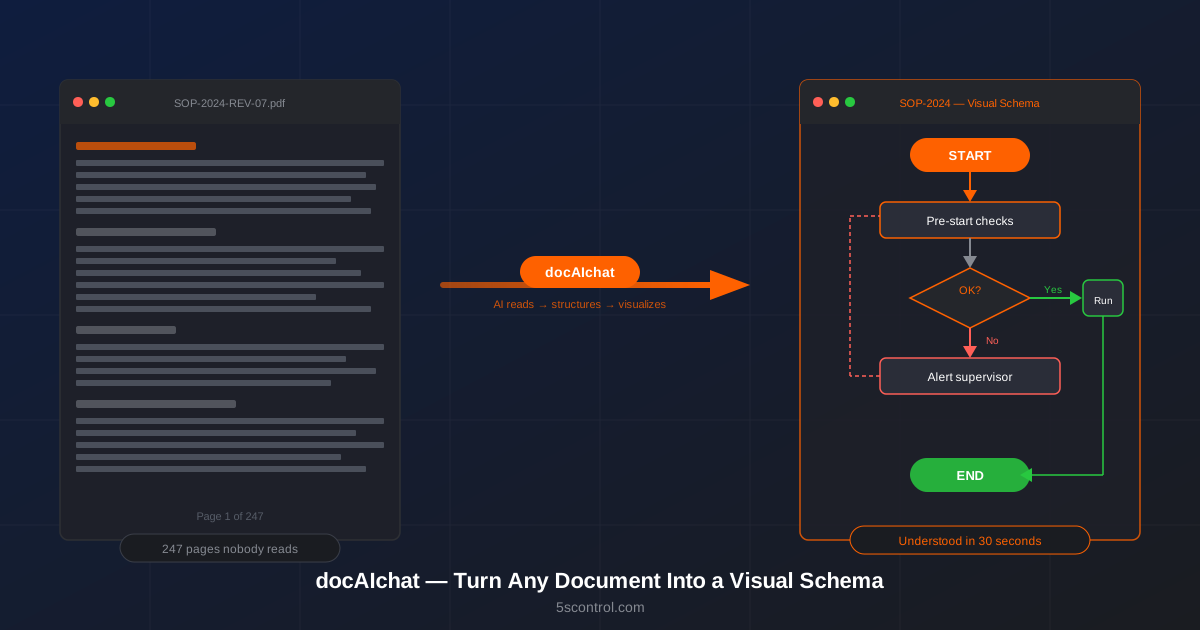
Why Nobody Reads Your Manufacturing Docs — And What docAIchat Does About It
Your SOP library has 400 pages. Your maintenance team has read maybe 40 — and those 40 were the ones printed and taped to the wall six years ago. That's not a discipline problem. That's a format problem.
Plain text doesn't work on the factory floor. Workers don't think in paragraphs. They think in sequences: do this, then that, if this happens do that instead. A 12-step procedure buried in a Word document isn't less correct than a flowchart — it's just less usable. And usability is the whole point.
The real cost of unread documentation
When technical knowledge stays locked inside documents nobody opens, it shows up elsewhere: in repeat quality defects, in equipment downtime that wasn't supposed to happen, in safety incidents that the SOP would have prevented, in onboarding that takes three times longer than it should because the tribal knowledge lives with one person who's about to retire.
Audit season makes this especially visible. An inspector asks how a process is controlled. The answer exists — it's in a document. But nobody can find it, nobody can explain it quickly, and the version on the floor is two revisions old. The knowledge was there. The comprehension wasn't.
What docAIchat does
docAIchat is a new AI engine that reads your technical documents and turns them into visual schemas. Upload a standard operating procedure, an equipment manual, a compliance specification, or a set of work instructions. The engine parses the structure, identifies processes, dependencies, decision points, and sequences — and generates a visual representation you can actually navigate.
It also answers questions. Ask "what are the pre-start checks for Line 3?" and get an answer drawn from your own documents, with a visual diagram of the relevant steps. No more searching through PDFs. No more hoping someone remembers the right page number.
Where it changes the daily work
Equipment manuals. A 200-page manual for a CNC machine contains maybe 15 pages your operators actually need. docAIchat surfaces those — as a visual maintenance flow, a fault diagnosis tree, a startup checklist — without anyone having to read the other 185 pages first.
SOPs and work instructions. Text-based procedures get converted into step-by-step diagrams that workers can follow at the line without interpretation. The SOP doesn't change — its form does. A technician scanning a QR code gets a visual schema, not a PDF attachment.
Compliance documentation. ISO 9001, IATF 16949, OSHA standards — these documents are written for auditors, not for the people doing the work. docAIchat bridges that gap: extract the requirements that apply to a specific role or process, and present them as an actionable visual checklist rather than a wall of regulatory text.
Training and onboarding. New operators typically learn by watching someone experienced. When that person is unavailable or leaves, the knowledge gap is immediate. Visual schemas built from existing documentation give new hires a structured, consistent starting point — one that doesn't depend on who happens to be on shift.
The outcome isn't just better documents
The goal isn't prettier PDFs. It's the thing that happens downstream: fewer errors on repetitive tasks, faster diagnosis when something goes wrong, audit readiness that doesn't require a scramble, and a workforce that can actually apply the knowledge your organization has already documented.
Comprehension and compliance are not the same thing — but comprehension is what makes compliance possible. A worker who understands why a procedure exists follows it differently than one who's just been told to.
5S Control's AI monitors your production floor in real time. docAIchat connects that to your documented standards — the SOPs, specifications, and procedures your operations are built on. The result: a closed loop between what's happening and what's supposed to happen. That gap is where most avoidable errors live.